Guides · Lady Lake, Florida
The History of Lady Lake in 6 Landmarks
The railroad doesn’t stop here anymore, but Lady Lake was built on the logic of it: tracks first, town second, and everything else—citrus, houses, even a retirement empire—followed the rails.
The Lake That Named the Town
Before there was a town, there was the lake. Lady Lake sits beside the water that gave it its name, and that is not a small detail. In Florida, place names usually arrive with a story attached—a surveyor’s joke, a land grant, a misspelling on a map. Here, the name is just geography, plain and literal. The lake was there first, and the town took its cue.
The ground around it belonged to the Seminole before it belonged to anyone with a surveyor’s chain. That history is easy to skip over in a town that now thinks in decades, not centuries, but it matters. The land was not empty when the rails came. It was claimed, and then it was changed.
The Railroad Right-of-Way
Around 1883, Lady Lake became a railroad town. The Atlantic Coast Line Railroad ran a line through this part of Lake County, and the town grew up alongside it. That is not romantic. Railroads were infrastructure, and infrastructure is what made inland Florida survivable. Without the tracks, there was no easy way to move people, goods, or—crucially—fruit out of the interior. With them, a settlement could actually become a place.
The railroad shaped the town physically and economically. The line that ran through Lady Lake was part of the High Springs–Croom route, and it did what railroads did: it connected a small, hot, mosquito-heavy patch of scrub to the wider world. The town incorporated in 1925, more than four decades after the tracks arrived. That lag tells you something. The railroad made the town possible, but it took time for the town to decide it was official.
The Citrus Economy
Citrus came because the railroad made it viable. Oranges and grapefruit do not ship well by mule. The groves around Lady Lake needed a fast, reliable route to market, and the Atlantic Coast Line provided it. The citrus industry became the town’s economic engine, and it is the reason Lady Lake had a reason to exist beyond being a nice spot by a lake.
The evidence of that era is not in the groves—most of those are gone, replaced by rooftops—but in what the town saved. The local museum holds citrus-industry artefacts: tools, photographs, the material culture of a time when the town’s fortunes rose and fell with the harvest. It is a modest collection, but it is honest. It does not pretend the town was ever a metropolis. It records what was actually here.
The Atlantic Coast Line Structure
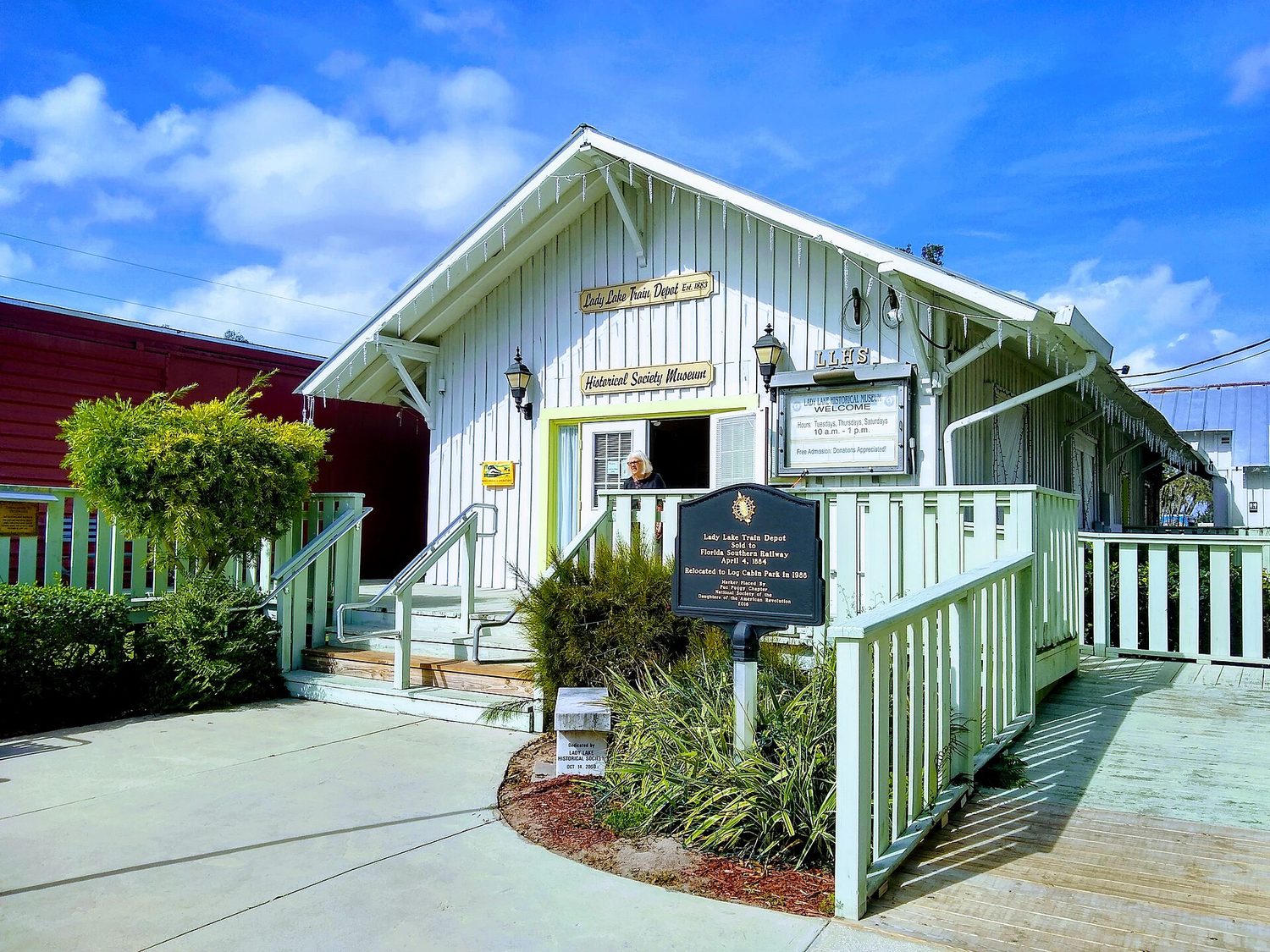
The Lady Lake Historical Society Museum lives in a building the Atlantic Coast Line Railroad built for its High Springs–Croom line. That is the kind of fact that sounds dry and is actually remarkable. The building survived. The railroad that justified it did not, and neither did the citrus economy that depended on it. What remains is the structure, repurposed as a museum, holding the town’s memory.
The museum’s collection includes an HO gauge railroad—a miniature echo of the real thing—along with tools and photographs. It is a small-town museum, which means it holds what the town decided was worth keeping. That is both its charm and its limit. You will not find a world-class art collection. You will find the stuff of a place that was built by trains and trees and stayed small enough to remember it.
The Log Cabin on West Lady Lake Boulevard
In front of the museum stands a log cabin on West Lady Lake Boulevard. It is not a replica, not a theme-park prop. It is a real log cabin, and it sits where it sits, in front of the railroad structure, as a reminder that the town’s history is not just industrial. People lived here before the trains and the groves. They built with logs because that is what was available.
The cabin and the museum together make a strange pair: one built from the land, the other built for the railroad that connected the land to the market. Standing between them, you can see the whole arc of Lady Lake’s early history without reading a single plaque. The cabin is the beginning. The railroad building is the middle. The museum inside it is the town’s attempt to hold on to both.
The Birthplace of Something Bigger
Lady Lake is also the birthplace of The Villages. That is a fact the town cannot escape, and it is not a small one. The retirement community that grew into a sprawling, self-contained world started here. It did not start as a master plan. It started as a trailer park, grew into something larger, and eventually became the demographic center of gravity for the entire region.
The numbers tell the story. Lady Lake’s median age is 66.2 years. Its population is 16,337, spread across 10,056 housing units, of which 1,212 are held for seasonal or recreational use. The median home value is $217,900, and the median gross rent is $1,361. The unemployment rate is 6.7 percent, and the median household income is $47,260. For context: 24.8 percent of residents hold a bachelor’s degree or higher, and 1,443 housing units sit vacant.
That is a town shaped by retirement, and it is a town shaped by the fact that its most famous export grew out of it. Lady Lake does not get to be a quiet little railroad town anymore. It is the ancestor of a phenomenon, and that changes how the town sees itself—whether it wants to admit it or not.
What the Landmarks Add Up To
Six landmarks is a small number for a town with a century and a half of history, but Lady Lake has never needed many. The lake, the railroad, the citrus, the museum, the cabin, and the retirement community: that is the whole story, compressed. It is a story about transportation and agriculture, about a town that got its start because trains ran through it and its identity because oranges grew around it.
The railroad is gone. The groves are mostly gone. The town remains, and it remains because it kept adapting—from Seminole land to railroad stop to citrus hub to retirement haven. The landmarks are not monuments to a lost past. They are the physical evidence of a place that has always been willing to become something else.
The museum and the cabin still stand on West Lady Lake Boulevard. The lake is still there. The trains are not, and the oranges are fewer, but the town is not finished. It just keeps changing, the way it always has.
Every business named above is one we hold a listing for, and every date traces to a source on our sources page. We do not describe menus, interiors or service we have not verified. Details change — confirm before you travel.